
Holistic Wellness Insights: Exploring Balanced Lifestyles, Nutritional Principles, and Natural Vitality
An independent knowledge portal dedicated to explaining the principles of balanced nutrition, physical activity, and sustainable daily habits — without advice, recommendations, or promises of any outcome.
Fundamentals of Balanced Nutrition: Macro- and Micronutrients
A balanced diet is generally understood as one that supplies the full range of nutrients the body requires for everyday physiological function. Nutritional science categorises these into two broad groups: macronutrients, which provide energy substrates, and micronutrients, which facilitate regulatory and structural processes.
Understanding the role and dietary sources of each nutrient group offers context for interpreting food labels, dietary guidelines, and general nutritional literature.
- Macronutrients — proteins, fats, carbohydrates — are required in larger quantities and serve as primary fuel and structural materials.
- Micronutrients — vitamins and minerals — are needed in smaller amounts but are no less essential to biochemical processes.
- Dietary fibre, while not traditionally classified as a nutrient, plays a recognised role in digestive function and is documented in most modern nutritional frameworks.
Informational Context
The table below presents general nutritional reference information drawn from publicly available scientific literature. It does not constitute individual dietary advice. Nutritional requirements vary considerably between individuals.
| Nutrient Type | Examples | Primary Dietary Sources | General Role |
|---|---|---|---|
| Proteins | Amino acids (essential & non-essential) | Legumes, eggs, fish, nuts, whole grains | Tissue construction and repair; enzyme synthesis |
| Carbohydrates | Simple sugars, complex starches, dietary fibre | Cereals, root vegetables, fruits, legumes | Primary energy source; supports digestive function |
| Fats | Saturated, unsaturated, polyunsaturated | Olive oil, nuts, seeds, avocado, oily fish | Energy reserve; fat-soluble vitamin absorption |
| Vitamins (fat-soluble) | A, D, E, K | Leafy greens, dairy, liver, fortified foods | Vision, immune function, bone metabolism, clotting |
| Vitamins (water-soluble) | B-complex, C | Citrus fruits, whole grains, legumes, vegetables | Energy metabolism; collagen synthesis; immune support |
| Macrominerals | Calcium, Magnesium, Potassium | Dairy, leafy greens, bananas, seeds | Bone structure; muscle contraction; fluid balance |
| Trace minerals | Iron, Zinc, Selenium | Legumes, meat, seafood, whole grains | Oxygen transport; immune function; antioxidant activity |
| Dietary Fibre | Soluble and insoluble fibre | Oats, flaxseed, chia, beans, vegetables | Digestive regularity; satiety; gut microbiome support |
Sources: General nutritional reference data from publicly available academic and institutional publications. Data represents broad averages and is not prescriptive.
The Role of Physical Activity in Maintaining Tone
Physical activity encompasses a wide spectrum of movements — from structured exercise to incidental daily motion such as walking, gardening, or cycling to work. Public health literature consistently identifies regular movement as a significant contributing factor to general physiological wellbeing.
Varieties of Physical Activity
Activities are commonly categorised by their primary physiological demand. Aerobic or cardiovascular exercise — such as brisk walking, swimming, or cycling — engages the heart and respiratory system over sustained periods. Resistance-based activities, including bodyweight movements and light strength work, support muscular endurance and skeletal integrity. Mind-body practices such as yoga, tai chi, or mindful stretching emphasise controlled movement, breathing, and body awareness.
General Observations from Research
Public health frameworks and epidemiological studies have noted consistent associations between regular moderate physical activity and indicators such as cardiovascular function, mood regulation, energy levels, and metabolic balance. These associations are contextual and influenced by numerous individual factors including age, existing health status, and lifestyle context.
The information presented here describes documented observations from population-level research and does not constitute guidance for any individual's activity choices.

The Importance of Hydration for Daily Activity
"Water constitutes approximately 60% of adult body mass and is involved in virtually every metabolic process the body performs."
Why Hydration Is Discussed in Wellness Contexts
Water is a fundamental constituent of blood plasma, cellular fluid, digestive secretions, and thermal regulation mechanisms. It functions as both a transport medium — carrying nutrients to cells and removing metabolic by-products — and as a structural element within tissue.
Hydration status is influenced by a range of variables including ambient temperature, physical exertion, dietary content, and individual physiology. Foods with high water content — such as cucumbers, watermelon, leafy greens, and soups — contribute meaningfully to daily fluid intake alongside drinking water.
Electrolytes and Fluid Balance
Fluid balance is not regulated by water alone. Electrolytes — including sodium, potassium, and magnesium — govern the movement of water across cell membranes and the electrical activity of muscles and nerves. These minerals are obtained primarily through food and are central to the body's ability to maintain homeostatic balance.
Observable Indicators
Physiological indicators commonly used in nutritional education to illustrate hydration status include urine colour, frequency of urination, and subjective sensations such as dry mouth or reduced cognitive clarity. These indicators are discussed in educational and public health literature as broad contextual reference points — not as diagnostic tools.
Building Sustainable Healthy Habits
Behavioural science and public health research describe habit formation as a gradual, iterative process. The principles below represent broadly documented observations on how consistent, moderate approaches tend to sustain over time — presented here as informational context, not as personal guidance.
Consistency Over Intensity
Research in habit psychology suggests that smaller, regularly repeated behaviours tend to integrate more durably into daily routines than large, infrequent efforts. The principle of gradual accumulation is described across multiple frameworks in behavioural nutrition and public health.
Variety and Moderation
Nutritional literature frequently frames dietary diversity — consuming a wide range of food groups — as a strategy that supports adequate micronutrient intake without reliance on any single food source. Moderate, flexible approaches are commonly discussed as more adaptable to real-life conditions than rigid restriction.
Environmental Context
Studies on behaviour change highlight the role of the immediate environment — food availability at home, proximity to green spaces, daily schedules — in shaping eating and activity patterns. These environmental factors are presented in wellness literature as contextual influences rather than absolute determinants.

The Impact of Rest and Daily Routine on Overall Balance
Sleep and structured daily routines are subjects of extensive documentation in neuroscience, endocrinology, and public health. Their relationship with physiological and psychological balance is among the most consistently studied areas of lifestyle science.
Sleep and Physiological Processes
During sleep, the body undergoes a range of restorative processes including hormonal regulation, cellular repair, and the consolidation of memory and learning. Sleep duration and quality are associated in population studies with a broad range of health indicators, including metabolic function, immune response, and emotional regulation.
Stress and the Body's Response
Chronic stress — defined in physiological terms as sustained activation of the body's stress-response systems — has been widely studied in relation to its downstream effects on appetite regulation, sleep architecture, and energy levels. This area is discussed extensively in psychoneuroimmunology and related fields.
The Role of Routine
Consistent daily schedules, including regular meal timing, structured activity periods, and predictable sleep windows, are described in circadian biology research as factors that support the synchronisation of the body's internal timing systems. These observations are presented here as documented scientific context.
Natural Products for Diet Enrichment
Certain natural food ingredients are documented in nutritional literature for their characteristic nutrient profiles. The following examples — chia seeds, spirulina, and flaxseed — are described here purely in terms of their compositional properties as part of a broader, balanced dietary context. No specific health effects, curative properties, or individual outcomes are implied.
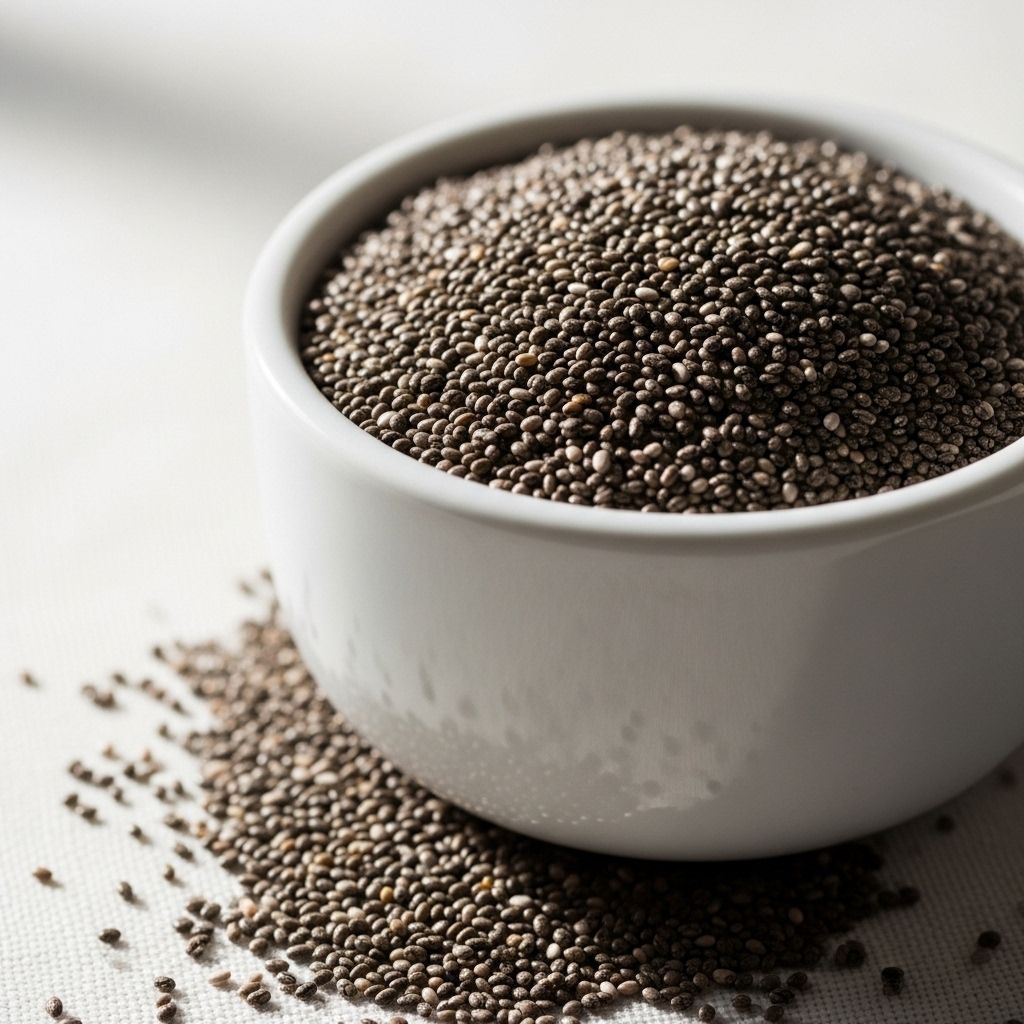
Chia Seeds
Chia seeds (Salvia hispanica) are documented as a source of omega-3 fatty acids (ALA), soluble dietary fibre, calcium, magnesium, and phosphorus. When hydrated, they form a gel-like consistency due to their high soluble fibre content. They are commonly incorporated into porridges, smoothies, and baked preparations within balanced dietary patterns.

Spirulina
Spirulina is a blue-green microalgae cultivated as a dietary supplement and food ingredient. Its nutritional profile includes a high proportion of protein relative to its dry mass, B vitamins (excluding B12 in meaningful amounts), iron, and phycocyanin — a pigment-protein compound. It is typically consumed in powder or tablet form as a supplementary addition to standard dietary intake.

Flaxseed
Flaxseed (Linum usitatissimum) is documented as a plant source of alpha-linolenic acid (ALA), lignans — a class of polyphenolic compounds — and both soluble and insoluble dietary fibre. Ground flaxseed is noted in nutritional literature as having greater bioavailability compared to whole seeds. It is used as a flavour-neutral addition to cereals, yoghurts, and baked goods.
General Principles for Maintaining Form Without Radical Changes
-
Regularity of Movement
Population health research documents that consistent, moderate physical activity — accumulated across a week rather than concentrated in isolated intense episodes — is associated with measurable physiological indicators of wellbeing. Walking, cycling, and low-impact resistance work are frequently cited in public guidelines.
-
Dietary Structure and Satiety
Studies in nutritional epidemiology suggest that the composition and timing of meals — including the proportion of protein, fibre, and complex carbohydrates — can influence satiety signals and subjective energy levels throughout the day. This is described as a structural phenomenon, not as a prescriptive dietary model.
-
Fluid Balance as a Daily Variable
Hydration is documented across physiological literature as a variable that fluctuates with activity, climate, and dietary intake. Maintaining awareness of fluid consumption — through water and water-rich foods — is described in public health frameworks as a component of general daily self-monitoring.
-
Habit Formation Through Gradual Integration
Behavioural research on sustainable lifestyle change emphasises the role of incremental adjustments rather than abrupt overhauls. Replacing one element at a time — such as substituting a processed snack for a whole food option — is presented as a mechanism of gradual dietary improvement.
-
Rest as an Active Physiological Input
Sleep and recovery are characterised in exercise physiology and endocrinology as active physiological processes — not merely the absence of activity. Their role in hormonal balance, muscular repair, and cognitive function is extensively documented in peer-reviewed literature.
Frequently Asked Questions about Healthy Living
Continue Exploring Wellness Knowledge
Olaxis is an independent educational portal. All content is presented for informational purposes only, without individual recommendations, commercial intent, or promises of outcomes. Explore our full range of topics and reference materials below.
About the Information on This Site
All content on Olaxis is intended for general informational and educational purposes. It does not substitute for professional medical, nutritional, or healthcare advice. Individual circumstances vary widely; the information presented reflects documented scientific and public health literature without implying outcomes for specific readers. No individual recommendations are provided. Diverse approaches exist in everyday life and professional contexts.